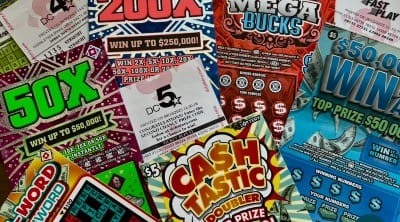
Why Play Lottery Scratcher Games? (part II)
Unlike Joan Ginther, I don't have such an annual infusion of lottery annuity payments rolling in, so my strategy requires me to play scratcher games where there are fewer retailers, fewer tickets and overall "better" odds of trying to sharpshoot my way to winning a top prize, even if the top prize is not in the millions of dollars. I just don't have the firepower she had, so I need to be more selective and tactical and wait for better odds. As it so happened, I used to travel to the Washington DC area for work every so often and I realized that the DC lottery effectively met my requirements. The DC website shows the location of some 300+ vendors in the district, all within easy driving distance. And the total numbers of printed tickets for any one game are in the low hundreds of thousands. Not in the millions, or tens of millions. The only question then was to see when or if a game would ever reach the tipping point of being worth pursuing.
So what is the tipping point? At one point is a scratcher game worth pursuing for an everyday average player? I suppose it depends on how one defines pursuing, i.e. how many tickets to buy in the first place. Dozens? Hundreds? Thousands? And of course it depends on one's bankroll and the amount they are willing to spend to go after a top prize. I'll only really start paying attention to a game as a possible future candidate when its payout rate rises into the mid-to upper 80% range and when the odds of winning the top prize are less than 1 in 100,000. Payout rate of course is the total value of remaining prizes divided by the total cost to buy all remaining prizes. But for me to really consider a game, I need to see a payout rate to be above 90% for most games. And the odds of winning the top prize ideally less than 1 in 50,000. I've seen games on rare occasions with payout ratios above 100% but I can't help but notice that the top prizes for those games don't often seem to ever get claimed. Either winners were accidentally thrown away or lost or . . . the lotteries took away unpurchased games from retailers and either knowingly or unknowingly took said top prize(s).
The other statistic that I will monitor is the overall odds of winning a game if $10,000 were spent chasing it. For that I want to see odds of less than 1 in 10. It has to be that close.
If on average a game returns 65-70% of the money spent buying it, then spending $1000 should return $650-$700 in smaller prizes, thus only costing the player $300-$350. Depending on the ticket price, that's a lot of tickets. $10 game? 100 tickets. $5 game? 200 tickets. But what about dropping $10,000 on a game, knowing that again, roughly 2/3 of it will come back to the player in smaller prize amounts regardless of whether a top prize is found? For me, if the odds of winning a game's top prize drop to less than 1 in 10 (if $10k is spent chasing it), and the overall payout rate is at least in the mid-90% range, and the overall odds of winning the top prize are 1 in 25,000 or less – then I'd be willing to go for it.
The other thing is that if the prize money is plowed right back in to buying additional tickets and if 2/3 of that prize money is then used to again buy more scratchers, pretty soon it becomes a "buy one ticket, get two free" scenario where the effective cost of buying scratchers is about 1/3 of the printed price. That's very appealing. As opposed to buying Powerball or Mega Millions tickets and hoping to get anything back at all.
Every day I access the scratcher games data from the DC Lottery website to update my own statistics. Want to know what are the best scratcher games worth playing?Subscribe now!